Brahma is the Hindu god (Deva) of creation and one of the Trimurti, the others being Vishnu and Siva. According to the Brahma Purana, he is the father of Manu, and from Manu all human beings are descended. In the Ramayana and the Mahabharata, he is often referred to as the progenitor or great grandsire of all human beings. He is not to be confused with the Supreme Cosmic Spirit in Hindu Vedanta philosophy known as Brahman, which is genderless. Brahma’s wife is Saraswati. Saraswati is also known by names such as Savitri and Gayatri, and has taken different forms. Saraswati is the Vedic Goddess, revered as Vedamata, meaning Mother of the Vedas. Brahma is often identified with Prajapati, a Vedic deity.
According to the Puranas, Brahma is self-born in the lotus flower. Another legend says that Brahma was born in water. A seed that later became the golden egg. From this golden egg, Brahma the creator was born, as Hiranyagarbha. The remaining materials of this golden egg expanded into the Brahmanda or Universe. Being born in water, Brahma is also called Kanja (born in water). Brahma is said also to be the son of the Supreme Being, Brahman, and the female energy known as Prakrti or Maya.
At the beginning of the process of creation, Brahma creates the four Kumaras or the Catursana. However, they refuse his order to procreate and instead devote themselves to God and celibacy.
He then proceeds to create from his mind ten sons or Prajapatis (used in another sense), who are believed to be the fathers of the human race. The Manusmrti and Bhagavat Purana enumerate them as Marici, Atri, Angira, Pulastya, Pulaha, Kratu, Vasistha, Daksa, Bhrgu, and Narada. Brahma had many other offspring from various parts of his body but since all these sons were born out of his mind rather than body, they are called Manas Putras or mind-sons or spirits.
Within Vedic and Puranic scripture Brahma is described as only occasionally interfering in the affairs of the other devas (gods), and even more rarely in mortal affairs. He did force Soma to give Tara back to her husband, Brhaspati. Among the offspring from his body are Dharma and Adharma, Krodha, Lobha, and others.
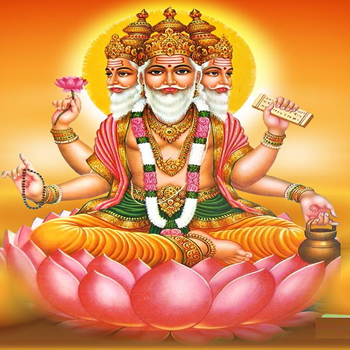
Brahma is traditionally depicted with four heads, four faces, and four arms. With each head, He continually recites one of the four Vedas. He is often depicted with a white beard (especially in North India), indicating the nearly eternal nature of his existence. Unlike most other Hindu gods, Brahma holds no weapons. One of his hands holds a scepter. Another of his hands holds a bow. Brahma also holds a string of prayer beads called the ‘aksamala’ (literally “garland of eyes”), which He uses to keep track of the Universe’s time. He is also shown holding the Vedas.
There are many other stories in the Puranas about the gradual decrease in Lord Brahma’s importance. Followers of Hinduism believe that Humans cannot afford to lose the blessings of Brahma and Sarasvati, without whom the populace would lack creativity, knowledge to solve mankind’s woes.
Symbols
The Four Faces – The four Vedas (Rk, Sama, Yajuh and Atharva).
The Four Hands – Brahma’s four arms represent the four cardinal directions: east, south, west, and north. The back right hand represents mind, the back left hand represents intellect, the front right hand is ego, and the front left hand is self-confidence.
The Prayer beads – Symbolize the substances used in the process of creation.
The Book – The book symbolizes knowledge.
The Gold – Gold symbolizes activity; the golden face of Brahma indicates that He is actively involved in the process of creating the Universe.
The Swan – The swan is the symbol of grace and discernment. Brahma uses the swan as his vahana, or his carrier or vehicle.
The Crown – Lord Brahma’s crown indicates His supreme authority.
The Lotus – The lotus symbolizes nature and the living essence of all things and beings in the Universe.
The Beard – Brahma’s black or white beard denotes wisdom and the eternal process of creation.
The Vedas Symbolises his four faces, heads and arms
Vehicle
Brahma’s vehicle or vahana is the hansa.
Temples
The 9th century Javan statue of Brahma inside the Brahma shrine in Trimurti Prambanan temple, Yogyakarta, Indonesia
Though almost all Hindu religious rites involve prayer to Brahma, very few temples are dedicated to His worship. Among the most prominent is the Brahma temple at Pushkar. Once a year, on Kartik Poornima, the full moon night of the Hindu lunar month of Kartik (October – November), a religious festival is held in Brahma’s honour. Thousands of pilgrims come to bathe in the holy Pushkar Lake adjacent to the temple.
Temples to Brahma also exist in Thirunavaya in Kerala, in the temple town of Kumbakonam in the Thanjavur District of Tamil Nadu in Kodumudi, Tamil Nadu in Asotra village in Balotra taluka of Rajasthan’s Barmer district, known as Kheteshwar Brahmadham Tirtha.In the coastal state of Goa,a shrine belonging to 5th century AD, in the small, remote village of Carambolim in the Sattari Taluka in the northeast region of the state is found. Regular pujas are held for Lord Brahma at the temple in Thirunavaya, and during Navrathris this temple comes to life with colourful festivities. There is also a shrine for Brahma within the Brahmapureeswarar Temple in Thirupatur, near Trichy, and a famous murti of Brahma exists at Mangalwedha, 52 km from the Solapur district of Maharashtra. Statues of Brahma may be found in Khedbrahma, Gujarat, and in Sopara near Mumbai. There is a temple dedicated to Lord Brahma in the temple town of Sri Kalahasti near Tirupati in Andhra Pradesh.
The largest and most famous shrine to Lord Brahma may be found in Cambodia’s Angkor Wat.
In Java, Indonesia, the 9th century Prambanan Trimurti temple mainly is dedicated to Siva, however Brahma and Visnu also venerated in separate large shrines inside the temple compound, a single large shrine dedicated to Brahma on southern side of Siva temple. There is a statue of Brahma at the Erawan Shrine in Bangkok. The golden dome of the Government House of Thailand also contains a statue of Phra Phrom (Thai representation of Brahma).
Sources : wikipedia & different online websites.