
Vishnu is a popular Hindu god, venerated as the Supreme Being in the Vaishnava sect.
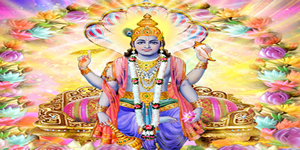 He is also commonly known as Narayana or Hari.In the Puranas, Vishnu is described as having the divine colour of water filled clouds, four-armed, holding a lotus, mace, shankha (conch) and chakra (wheel). Vishnu is also described in the Bhagavad Gita as having a ‘Universal Form’ (Vishvarupa) which is beyond the ordinary limits of human perception or imagination.
His eternal or permanent abode beyond the material universe is Vaikuntha which is a realm of eternal bliss and happiness. It is also known as Paramdhama, which means final or highest place for liberated souls, where they enjoy eternal bliss and happiness. Vaikuntha is situated beyond the material universe and hence, can not be perceived or measured by material science and logics.
His other abode within the material universe is Ksheera Sagara, where he reclines and rests on Shesha. It is known to be the topmost realm in the material universe, even higher than Satyaloka where Brahma resides. Vishnu manages and sustains the universe from there. Hence, Ksheera Sagara is also sometimes known as local Vaikuntha of the material universe, which is approachable by demigods in order to meet the lord in case of any emergency or disturbance in universal balance.
In almost all Hindu denominations, Vishnu is either worshipped directly or in the form of his ten avatara, most famous of whom are Rama and Krishna.
The number of auspicious qualities of Vishnu as the supreme God are countless, with the following six qualities being the most important:
• Jnana (Omniscience), defined as the power to know about all beings simultaneously
• Aishvarya (Sovereignty), derived from the word Ishvara, which consists in unchallenged rule over all
• Shakti (Energy), or power, which is the capacity to make the impossible possible
• Bala (Strength), which is the capacity to support everything by will and without any fatigue
• Virya (Vigor), which indicates the power to retain immateriality as the supreme being in spite of being the material cause of mutable creations
• Tejas (Splendor), which expresses His self-sufficiency and the capacity to overpower everything by His spiritual effulgence
According to various Purana, Vishnu is the ultimate omnipresent reality, is shapeless and omnipresent. However, a strict iconography governs his representation, whether in pictures, icons, or idols:
He is to be depicted as a four-armed male-form: The four arms indicate his all-powerful and all-pervasive nature. The physical existence of Vishnu is represented by the two arms in the front while the two arms at the back represent his presence in the spiritual world. The Upanishad titled Gopal Uttartapani describes the four arms of Vishnu.
Also on his chest is the srivatsa mark, symbolising his consort Lakshmi. It is on the chest of Vishnu, where Lakshmi resides.
Around his neck, he wears the auspicious “Kaustubha” jewel, and a garland of flowers (vanamaalaa). It is in this jewel, on Vishnu’s chest that Lakshmi dwells.
A crown should adorn his head: The crown symbolizes his supreme authority. This crown is sometimes depicted having a peacock feather, borrowing the iconography from image of his Krishna avataar.
He is to shown wearing two earrings: The earrings represent inherent opposites in creation — knowledge and ignorance; happiness and unhappiness; pleasure and pain.
He rests on Ananta: the immortal and infinite snake
Vishnu is always to be depicted holding the four attributes associated with him, being:
A conch shell or Shankha, named “Panchajanya”, held by the upper left hand, which represents Vishnu’s power to create and maintain the universe. The Panchajanya represents the five elements or Panchabhoota – water, fire, air, earth and sky or space. It also represents the five airs or Pranas that are within the body and mind. The conch symbolizes that Vishnu is the primeval Divine sound of creation and universal maintenance. it also represented as Om. In the Bhagavad Gita, Krishna avatara states that of sound vibrations, ‘He is Om’.
The chakra, a sharp-spinning discus-like weapon, named “Sudarshana”, held by the upper right hand, which symbolizes the purified spiritualized mind. The name Sudarshana is derived from two words – Su, which means good, superior, and Darshan, which means vision or Sight; together, it is “Superior Vision”. The chakra represents destruction of one’s ego in the awakening and realization of the souls original nature and god, burning away of spiritual ignorance and illusion, and developing the higher spiritual vision and insight to realize god.
A mace or Gada, named “Kaumodaki”, held by the lower left hand, symbolizes Vishnu’s divine power is the source all spiritual, mental and physical strength. It also signifies Vishnu’s power to destroy materialistic or demoniac tendencies called anarthas; within the person’s consciousness that hinders them from reaching god. Vishnu’s mace is the power of the Divine within us to spiritually purify and uplift us from our materialistic bonds.
A lotus flower or Padma, held by the lower right hand, represents spiritual liberation, Divine perfection, purity and the unfolding of Spiritual consciousness within the individual. The lotus opening its petals in the light of the Sun is indicative of the expansion and awakening of our long dormant, original spiritual consciousness in the light of god. The lotus in Vishnu’s hand symbolizes that god is the power and source from which the universe and the individual soul emerges. It also represents Divine Truth or Satya, the originator of the rules of conduct or Dharma, and Divine Vedic knowledge or jnana. The lotus also symbolizes that Vishnu is the embodiment of spiritual perfection and purity. Also that He is the wellspring of these qualities and that the individual soul must seek to awaken these intrinsic Divine qualities from Vishnu by surrendering to and linking with Him.
In general, Vishnu is depicted in one of the following three ways:
Standing upright on a lotus flower, often with Lakshmi, his consort, beside him on a similar pedestal;
Reclining on the coiled-up thousand-hooded Shesha Naga, with his consort Lakshmi, seated at his feet; the assemblage rests on the “Kshira Sagar” (ocean of Milk). In this representation, Brahma is depicted as sitting on a lotus that grows out of Vishnu’s navel.
Riding on the back of his eagle mount, known as Garuda. Another name for Garuda is “Veda atma”; Soul of the Vedas. The flapping of his wings symbolizes the power of the Divine Truth of Vedic wisdom. Also the eagle represents the soul. Garuda carrying Vishnu symbolizes the soul or jiva atma carrying the Super soul or Param atma within it.
Mantra
“Om Namo Narayanaya, Om Namo Bhagavate Vasudevaya,Om Vishnaveh Namaha“.
Dashavatara
There are ten avatars (dashavatara) of Vishnu commonly considered as the most prominent:
1. Matsya : the fish, appeared in the Satya Yuga. The Fish Incarnation is the first incarnation of Vishnu. Lord Vishnu takes the form of a fish to take a king to the new world along with one of every single species of plants and animals from the world’s largest cyclone. What we live in now is the new world, where the Lord traveled, carrying everything from the old, destroyed world.
2. Kurma : the tortoise, appeared in the Satya Yuga. The tortoise Incarnation is the second incarnation of Vishnu. When the devas and asuras were churning the ocean in order to get the nectar of immortality, the mount Mandara they were using as the churning staff started to sink and Lord Vishnu took the form of a tortoise to bear the weight of the mountain.
3. Varaha : the boar, appeared in the Satya Yuga. The Boar incarnation is the third incarnation of Vishnu. He appeared in order to defeat Hiranyaksha, a demon who had taken the Earth (Prithvi) and carried it to the bottom of what is described as the cosmic ocean in the story. The battle between Varaha and Hiranyaksha is believed to have lasted for a thousand years, which the former finally won. Varaha carried the Earth out of the ocean between his tusks and restored it to its place in the universe.
4. Narasimha : the half-man/half-lion appeared in the Satya Yuga. The Man-Lion Incarnation is the fourth incarnation of Vishnu. When the demon Hiranyakashipu acquired a boon from Brahma, which gave him inordinate power, Lord Vishnu appeared in the form of half-man/half-lion, having a human-like torso and a lower body, but with a lion-like face and claws. Now, Hiranyakashipu had thought well before wishing for a boon. He asked for a boon that no man, god, or deva could kill him; he should neither be killed at day nor night; neither indoors nor outdoors; neither on earth nor space and neither animate nor inanimate. Hiranyakashipu could not be killed by human, deva or animal, Narasimha is neither one of these, as he is a form of Vishnu incarnate as a part-human, part animal. He comes upon Hiranyakashipu at twilight (when it is neither day nor night) on the threshold of a courtyard (neither indoors nor out), and puts the demon on his thighs (neither earth nor space). Using his sharp nails (neither animate nor inanimate) as weapons, he disembowels and kills the demon.
5. Vamana :, the dwarf, appeared in the Treta Yuga. The fourth lineal descendant of Hiranyakashyap, named Bali, through his devotion and penance defeated Indra, the god of firmament, humbled other gods and extended his authority over the three worlds. All the gods appealed to Lord Vishnu for protection and He became manifest in His Dwarf Avatar of Vaman for the purpose of restraining Bali. Once when this king was making a great religious offering, Lord Vishnu in the form of Vaman appeared before him in the company of other Brahmins. Bali was extremely pleased to see a holy man with such a diminutive form and promised to give him whatever he should ask. Lord Vishnu asked only for as much land as he could measure by three steps. Bali laughingly agreed to grant the boon of three steps. Lord Vishnu as dwarf stepped over heaven in first stride and netherworld in the second stride. Then he asked Bali where can he put his third step . Bali realized that Vamana was Vishnu incarnate and he was going to take the Earth in his third stride. He offered Vamana to put his third step on his head. Vamana did so and thus blessed Bali marking him as one of the few immortals blessed by Vishnu. Then out of respect to Bali’s kindness and his grandfather Prahlad’s great virtues, he made him the ruler of pathala, the subterranean region. Bali is believed to have ruled Kerala and Tulunadu. He is still revered there as the king of prosperity and remembered and called on before the harvesting season.
6. Parashurama : Rama with the axe, appeared in the Treta Yuga. Parashurama a Brahmin, the sixth avatar of Vishnu, belongs to the Treta yuga, and is the son of Jamadagni and Renuka. Parashu means axe, hence his name literally means Rama-of-the-axe. He received an axe after undertaking a terrible penance to please Shiva, from whom he learned the methods of warfare and other skills. Parashurama is said to be a “Brahma-Kshatriya” (with the duties between a Brahmana and a Kshatriya), the first warrior saint. His mother is descended from the Kshatriya Suryavanshi clan that ruled Ayodhya and Lord Rama also belonged to. A Haihaya King Kartavirya Arjuna (Sahasrarjuna – purportedly with a thousand arms) and his army visited Jamadagni, a Brahmin sage, who fed his guest and the whole army with his divine cow Kamadhenu. The king demanded the magical cow. Jamadagni refused because he needed the cow for his religious ceremonies. King Kartavirya Arjuna (Sahasrarjuna) took the cow forcibly and devastated the ashram. Angered at this, Parashurama killed the king’s entire army and, after cutting each one of his thousand arms, the king himself with his axe. As a revenge, the King’s sons killed Jamadagni in Parashurama’s absence. Furious at his father’s murder, Parashurama killed all sons of Sahasrajuna and their aides. His thirst for revenge unquenched, he went on killing every adult Kshatriya on earth, not once but 21 times, filling five ponds with blood. These are the actions which highlight his warrior characteristics. Ultimately, his grandfather, Richeek Rishi, appeared and stopped him.
7. Rama : Ramachandra, the prince and king of Ayodhya, appeared in the Treta Yuga. Rama is one of the most commonly adored gods in Hinduism and is known as an ideal man and hero of the epic Ramayana. Rama defeated and killed the king of Lanka, Ravana for capturing and imprisoning his wife Sita in the Ashoka Vatika [lit. Ashoka Garden] in Lanka.
8. Balarama : is considered as the eight avatar as per south Indian belief and Krishna as the ninth. As per the North Indian belief, Krishna is the eighth avatar[citation needed] According to the Bhagavata Purana, Balarama is said to have appeared in the Dwapara Yuga (along with Krishna) as an incarnation of Ananta Shesha. Krishna (meaning ‘dark coloured’ or ‘all attractive’) appeared in the Dwapara Yuga along with his brother Balarama. Krishna is one of the most commonly worshipped deities in the Hindu faith and is also counted as an avatar of Vishnu by the majority of Vaishnava movements. He is also a significant character in the epic of Mahabharata. Krishna delivered Bhagwad Gita on the battlefield of the Battle of Kurukshetra to Arjuna. He, like Rama, is also known for his bravery in destroying evil powers throughout his life. He is usually depicted as playing the flute (murali), indicating spread of the melody of love to people.
9. Krishna : the eighth son of Devaki and Vasudev, is belived to be an incarnation of Lord Vishnu. Buddha the ascetic prince is also listed as an avatar of Vishnu in many Hindu scriptures including Bhagavata Purana, Bhavishya Purana, Narasimha Purana etc. Kali Yuga sets in; in this age, the true devotion to Vedas was replaced by empty rituals.
10. Kalki : (“Eternity”, or “time”, or “The Destroyer of foulness”), who is expected to appear at the end of Kali Yuga, the time period in which we currently live. The tenth and the last avatar of Vishnu, Kalki, is yet to appear. This avatar will appear seated on a white horse with a drawn sword blazing like a comet. He shall come finally to destroy the wicked, to restart the new creation and to restore the purity of conduct in people’s lives. Kalki will move with a ‘great speed’, on a ‘Big’ ‘White’ ‘horse’ with a ‘sword’ in his hand. This description also comments on the astrological facts with regard to the planetary positions at the birth of Kalki i.e. Moon in Dhanishtha (Very swift, Most Famous, the richest) (Aquarius sign) (“Great Speed” of action & thoughts), Sun in swati, the only nakshatra associated with sword nakshatra, Jupiter in Purva Ashadha nakshatra [“Horse-Sagittarius sign”, “the invincible” “early victory” ], Ascendant Lord in Purva ashadha Nakshatra [“Horse” and Early Victory significance], Saturn exalted in Libra [“Justice” & “balance” & “sword”] and Ketu (lord of horse headed Ashwini) exalted in Scorpio [“Big & White Horse”]. Birth year can be derived from Jupiter, Saturn and Ketu; Sun can give the birth month, moon birth day and finally ascendant lord the birth hour.
Sources : wikipedia & different online websites.